

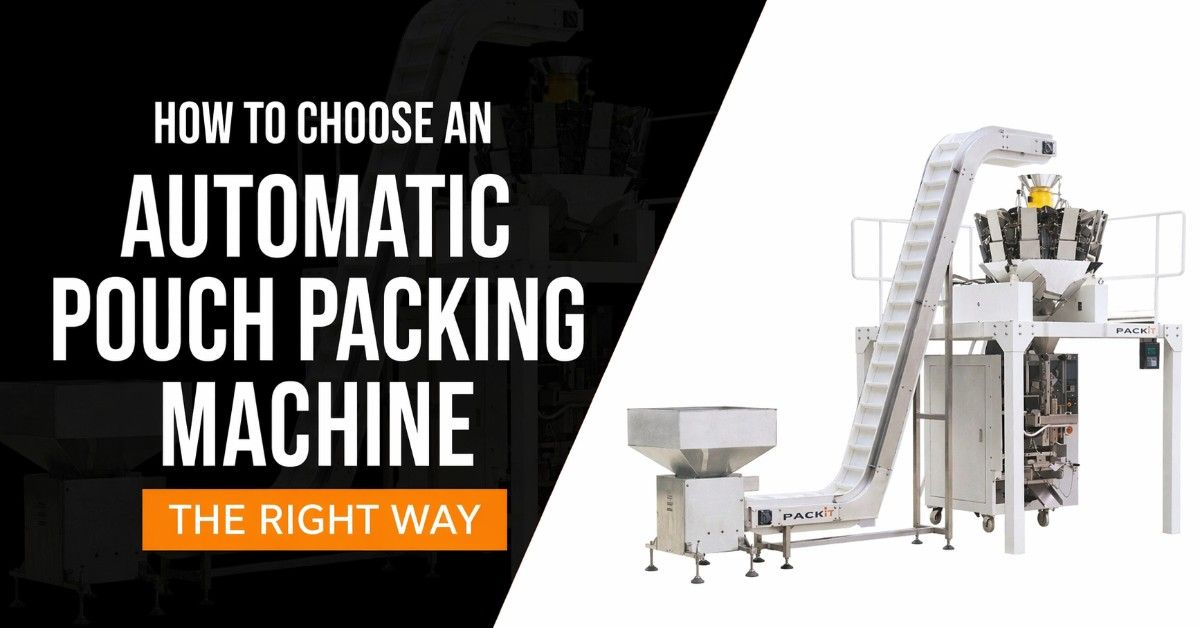
You have built your product. Your recipes are dialed in. Your production team is ready. But there is one challenge quietly holding you back at packaging.
Whether you run a namkeen unit in Rajasthan, a spice brand in Gujarat, or a snack startup selling flavored nuts online, the wrong packaging setup costs you more than just time. It costs you consistency, customer trust, and market credibility.
That is exactly why choosing the right automatic pouch packing machine is one of the most critical decisions a manufacturer can make. And yet, it is also one of the most misunderstood.
This guide walks you through what actually matters when evaluating a pouch packing machine, what mistakes to avoid, and how to match a machine to your real production needs.
Why So Many Businesses Get This Decision Wrong
Most buyers walk into this decision focused on just one or two factors, usually the machine size or the output speed. They end up with a machine that either underperforms for their current volume or cannot scale when their business grows.
The truth is, selecting an automatic pouch packing machine involves understanding your product type, your production environment, your packaging material, and your long-term business goals. Each of these elements plays a role in determining which machine is actually the right fit.
Let us break it all down.
Step 1: Understand What You Are Packaging
Before you even look at machine specifications, get clear on your product. Ask yourself:
Is your product a free-flowing granule like sugar, salt, or popcorn? Is it a powder like atta, protein mix, or spices? Is it an irregular solid like chips, dry fruits, or candy? Or is it a liquid or semi-liquid like sauce or oil?
Each product category behaves differently inside a packaging line. A granular product flows easily through volumetric cup fillers. A fine powder like turmeric or coffee needs an auger filler for accuracy. An irregular solid like namkeen or chips works best with a multihead weigher that handles product gently without crushing it.
Getting this right at the start saves you from investing in a machine that simply is not built for your product.
Step 2: Know Your Pouch Type and Packaging Material
Not all pouches are the same, and not all machines handle every pouch format. The most common formats include pillow pouches, gusseted pouches, stand-up pouches, and stick packs.
A VFFS machine (Vertical Form Fill Seal) is the most widely used solution for high-speed pouch production across food, FMCG, and industrial goods. It forms the pouch from a roll of film, fills it with the product, and seals it, all in one continuous motion. This is the backbone of most modern packaging production lines.
The packaging material also matters. Laminated films, polyester, BOPP, and metalized films all behave differently under heat sealing. Your machine needs to be compatible with the film type your brand uses, because poor seal quality directly leads to product leakage, customer complaints, and shelf returns.
Step 3: Match Machine Speed to Your Production Target
Speed is often the first number people ask about, but it needs to be read in context.
A machine rated at 60 pouches per minute sounds impressive. But if your filler takes 2 seconds per cycle, or your product is sticky and tends to clump, you will rarely hit that peak number in practice.
When evaluating an automatic packaging machine, ask for the realistic output speed under your specific product conditions, not just the maximum rated speed. Reputable manufacturers will give you honest benchmarks based on your product type and pouch size.
For a small snack brand producing 500 kg per shift, a machine running 30 to 40 pouches per minute may be perfectly sufficient. For an established atta or spice brand running two or three shifts a day, you may need a high-speed VFFS machine capable of 80 to 100 pouches per minute.
Scale your machine to your actual production reality, not your aspirational one.
Step 4: Evaluate Sealing Quality and Accuracy
Two things determine whether your packaged product reaches the customer in perfect condition: seal integrity and fill accuracy.
Seal integrity is about whether the pouch stays closed under handling, storage, and transport. A weak seal means product spillage, contamination risk, and damaged brand reputation. Look for machines with servo-driven sealing systems that maintain consistent temperature and pressure across every pouch.
Fill accuracy is equally critical. In regulated categories like spices, protein powders, or pharmaceutical-adjacent products, being even a few grams off on every pouch creates compliance issues and product losses at scale. Modern automatic pouch packing machines use PLC-based control systems and precision fillers to keep variation within acceptable limits across thousands of cycles.
If you are packaging premium dry fruits or branded snacks, your customers expect the weight on the label to match what is inside. Accuracy is not optional here.
Step 5: Think About Maintenance and Downtime
A machine that is difficult to maintain is a machine that will cost you far more over its life than its initial investment suggests.
Before finalizing any industrial packaging solution, ask the manufacturer these questions. How often does the machine require scheduled servicing? Are spare parts locally available or do they need to be imported? How long does changeover take when you switch between pouch sizes or products? Does the manufacturer provide on-site training and after-sales technical support?
Downtime on a packaging line is expensive. If your machine goes down during peak production and you have to wait weeks for a spare part or a service engineer, that directly impacts your order commitments and customer relationships.
Machines built with quality components, accessible service panels, and a robust local support network will always outperform cheaper alternatives over the long run.
Step 6: Consider Scalability
Your business today is not your business three years from now. When choosing an automatic pouch packing machine, think about whether it can grow with you.
Can the machine handle multiple pouch sizes without requiring a full replacement? Can you add a multihead weigher or upgrade the filler system later? Is the control interface intuitive enough that new operators can be trained quickly as your team expands?
Many growing food businesses start with a mid-range VFFS machine and later integrate it into a fully automated packaging line with conveyors, checkweighers, and metal detectors. Choosing a machine from a manufacturer that offers this ecosystem makes future upgrades far smoother.
Common Mistakes Manufacturers Make When Buying
Ignoring film compatibility until after delivery is one of the most common and costly errors. Always test your actual packaging film on the machine before committing.
Buying on speed alone without checking filler accuracy leads to machines that run fast but fill inconsistently.
Skipping a factory demonstration means you never see the machine running on your product type. Always insist on a live trial with your product or a close equivalent.
Overlooking after-sales support is a mistake that feels small on paper and enormous in practice. A machine without local support is a liability.
Where VS PacKit Fits Into This Decision
VS PacKit by VS International has spent over two decades building VFFS machines and pouch packing machines for some of India's most recognized food and FMCG brands, including Haldiram's, Parle, Patanjali, Bikanervala, and many more.
What sets VS PacKit apart is not just the technology. It is the approach. Their machines are built around real production environments, with servo-driven sealing, PLC automation, and user-friendly interfaces that operators can actually learn quickly. They hold two design patents, reflecting a genuine commitment to innovation rather than just assembling off-the-shelf components.
Their product range covers the full spectrum of packaging needs, from the Komet 81 and Indus 5000 for high-volume VFFS applications, to Servo Auger Fillers for powder products, to the SP-914 Stick Pack Machine for single-serve formats. Whether you are a startup in your first production facility or an established brand scaling your second factory, VS PacKit offers custom packaging solutions that fit the requirement.
For manufacturers across India looking for a trusted partner in industrial packaging solutions, VS PacKit is a name backed by proven performance across thousands of production lines.
Real-World Example: A Namkeen Brand Scaling Up
Consider a mid-size namkeen manufacturer based in Delhi NCR. They were running a semi-automatic line, packing around 80 kg per hour using manual labor. Quality was inconsistent. Seal failures were causing returns from distributors. Staff turnover meant retraining constantly.
After switching to a VFFS-based automatic pouch packing machine integrated with a multihead weigher, their output jumped to over 300 kg per hour. Fill accuracy improved significantly. Seal rejections dropped. And because the machine interface was straightforward, new operators could be trained within a day.
This is not an unusual story. It is a repeatable outcome when the right machine is matched to the right production context.
Final Thoughts
Choosing an automatic pouch packing machine is not just a procurement decision. It is a strategic one that shapes your production efficiency, product quality, and brand credibility for years to come.
Take the time to understand your product, match the machine to your actual output needs, evaluate sealing quality and fill accuracy seriously, and choose a manufacturer with a proven service track record.
If you are ready to take your packaging line to the next level, VS PacKit by VS International brings the technology, experience, and support to make that transition smooth, reliable, and built for growth.
Reach out to VS PacKit today and let their packaging experts help you find the right machine for your production line.