

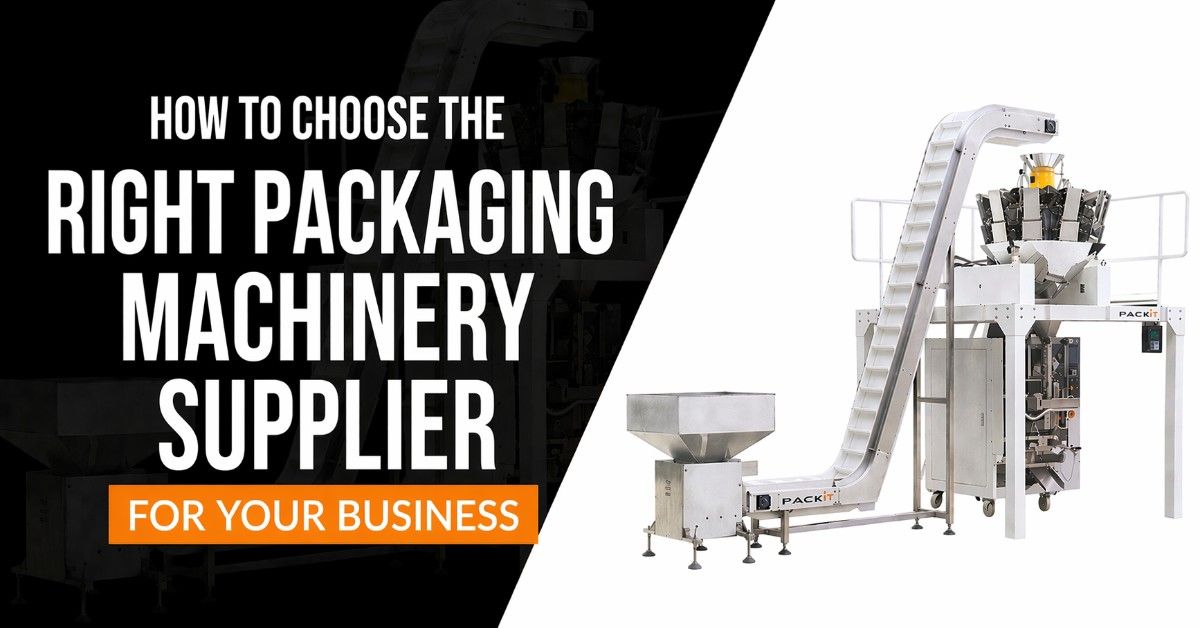
Nobody talks about the decision that happens before the machine arrives.
Everyone focuses on specifications, output speed, seal quality, filler accuracy. Those things matter enormously. But there is a step that comes before all of them, one that quietly determines whether every other decision you make about your packaging line turns out well or turns into an expensive lesson.
That step is choosing your packaging machinery supplier.
The machine is what you see on the factory floor. The supplier is the relationship that shapes everything around it. How the machine is specified, how it is installed, how quickly problems get resolved, how well the machine grows with your business over the next decade. All of that flows from the supplier you choose before a single bolt is tightened.
This guide is for food manufacturers, FMCG brands, factory managers, and startup founders who are about to make this decision and want to get it right the first time.
Why This Decision Carries More Weight Than Most Buyers Realize
Here is a scenario that plays out more often than it should.
A growing snack brand in Maharashtra shortlists three packaging machinery suppliers. Two are well-established with documented track records. One is newer, offering what appears to be a comparable machine at a lower commitment level. The brand chooses the third, motivated by the apparent flexibility in negotiation and a smooth sales conversation.
Six months later, the machine is underperforming against promised output figures. A sealing jaw component needs replacement. The supplier's service team is based three states away. Lead time for the part is four weeks. The brand's production manager is spending more time managing the packaging problem than managing the packaging line.
This is not an unusual story. It is a predictable outcome of a decision made without the right evaluation framework.
A packaging machine will sit on your production floor for ten, fifteen, sometimes twenty years. The supplier you choose will be your partner across every service call, every upgrade decision, every new machine purchase in that time. Treating the supplier selection as a secondary consideration to the machine specification is one of the most common and most costly mistakes in industrial buying.
What a Packaging Machinery Supplier Actually Provides
It is worth being precise about this because the word supplier is often used narrowly to mean the entity that sells you the machine. The reality is considerably broader.
A genuine packaging machinery supplier provides the machine itself, yes. But they also provide application engineering support to help you specify the right machine for your product and production environment. They provide installation and commissioning services to ensure the machine is set up correctly from day one. They provide operator training so your team can run the machine to its actual capability rather than a fraction of it.
They provide after-sales service including scheduled maintenance, emergency breakdown support, and spare parts supply over the machine's operational life. They provide technical guidance when you introduce a new product, change your packaging film, or want to expand your pouch format range. And they provide the institutional knowledge of what works and what does not across hundreds or thousands of similar installations in your industry.
When you evaluate a packaging machinery supplier, you are not just evaluating a product. You are evaluating an organization and its capacity to deliver all of these things reliably across a relationship that will span years.
The Questions That Reveal Who You Are Really Dealing With
Good suppliers welcome hard questions. They have answers ready because they have earned those answers through experience. Here are the questions that matter most.
How long have you been manufacturing and supplying this type of machine? A supplier with two decades of history in VFFS or automatic packaging machine supply has navigated a range of real-world problems and developed solutions for them. A newer entrant may have excellent engineering but limited operational wisdom.
Who are your current customers in my industry and can I speak with them? References from active customers in your sector tell you more than any demonstration. Ask specifically about after-sales experience, not just machine performance, because that is where supplier relationships are most tested.
Where is your service infrastructure? A supplier headquartered in one city with no regional service presence is a supplier whose support response time depends on travel distance. Understand exactly how they service machines in your geography before you commit.
What is the typical lead time for critical spare parts? Wear parts like sealing jaw inserts, forming collars, and drive belts need to be available quickly when they require replacement. A four-week lead time on a critical part is a four-week production vulnerability. Understand the supply chain before it matters.
How do you handle a situation where the machine is not performing to specification after installation? A supplier who has a clear, documented escalation process for this scenario is a supplier who has thought about what happens when things do not go perfectly. One who deflects this question is giving you important information about how they handle accountability.
What training do you provide to our operators and maintenance team? The quality and depth of initial training directly affects how well your team can operate and maintain the machine across its life. Ask for specifics, not just a general assurance that training is included.
Technical Competence: How to Assess It Without Being an Engineer
Most buyers are not packaging machine engineers. That is fine. But there are ways to assess technical competence without needing to evaluate every mechanical drawing.
Look at the quality of their documentation. A technically competent packaging machinery supplier produces clear, detailed machine manuals, maintenance schedules, and parts lists. If the documentation they provide is vague, poorly organized, or clearly translated from another language without care, that is a signal about the organization's internal standards.
Observe how they respond to your product-specific questions. When you describe your product, your film type, your pouch format, and your production environment, a technically strong supplier asks clarifying questions and provides specific recommendations. A supplier who responds with generic answers regardless of your specifics is either not listening or not equipped to apply their knowledge to your situation.
Ask about their engineering team and R and D investment. Suppliers who are genuinely advancing their technology file patents, invest in testing facilities, and employ experienced engineers. These are verifiable signals of technical seriousness.
Assess the quality of their machine demonstration. A well-prepared demonstration runs your product type or a close equivalent through the machine, shows seal quality across multiple cycles, demonstrates a changeover, and invites your team to observe the HMI and control interface. A demonstration that is tightly scripted to avoid revealing weaknesses is revealing in its own way.
Industry Experience: Why It Matters More Than General Capability
Packaging machines serve many industries but each industry has its own specific demands. A supplier with deep experience in food and FMCG packaging understands things that a generalist supplier may not.
They understand that oily snack products like namkeen and chips create seal contamination challenges that require specific jaw design and cleaning provisions. They understand that fine powders like spices and protein supplements need filler systems and seal zone designs that prevent product from landing on the seal area and compromising seal integrity. They understand that food-grade applications require stainless steel contact surfaces and hygienic machine designs that can be cleaned effectively without damaging components.
They understand the production rhythms of food manufacturing, including the importance of fast changeover for multi-SKU operations, the sensitivity of certain products to heat exposure during sealing, and the compliance requirements that apply to packaged food labeling and net weight accuracy.
A packaging machinery supplier with this depth of industry experience brings knowledge that accelerates your setup, prevents problems before they occur, and helps you make better decisions across the life of your packaging line. It is not something that can be substituted by general mechanical competence.
After-Sales Support: The Real Test of a Supplier Relationship
Every supplier will tell you their after-sales support is excellent. That is not useful information because no supplier describes their own service as poor. What is useful is a structured evaluation of what their after-sales infrastructure actually consists of.
Start with geography. Do they have service engineers stationed in your region or are all service personnel centralized at their manufacturing facility? Regional presence means faster response when you need on-site support. Centralized service means response time is a function of travel, which in a country the size of India can mean significant delays.
Ask about their spare parts inventory policy. Do they maintain a ready stock of commonly required wear parts, or are parts manufactured to order when requested? Ready stock means next-day or same-week availability. Made-to-order means weeks of waiting.
Ask about remote support capability. A supplier who can connect to your machine's control system remotely and diagnose faults in real time provides a level of support response that has become a meaningful differentiator in modern industrial service.
Ask about annual maintenance contracts and what they include. A supplier who offers structured preventive maintenance programs is managing your machine's long-term health proactively rather than just responding to breakdowns reactively.
And as noted earlier, speak to existing customers about their actual service experience. Not the installations that went perfectly but the ones where something went wrong. How the supplier responded in those moments is the most accurate predictor of how they will respond when you need them.
Scalability: Choosing a Supplier Who Can Grow With You
Your business will not stay the same size. Your product range will expand. Your production volume will increase. Your pouch formats and packaging materials will evolve. Your packaging machinery supplier needs to be equipped to support all of that.
A supplier with a broad product range can upgrade or expand your packaging line without requiring you to introduce a new supplier relationship. If you start with a single VFFS machine and later need to add a multihead weigher, an additional packing line, or a dedicated stick pack machine for a new product format, a supplier who offers all of these within their own portfolio is far more valuable than one who handles only a single machine type.
A supplier who stays current with technology developments can offer you upgraded capabilities as they become relevant to your operation. IoT-enabled monitoring, advanced servo systems, improved HMI interfaces, and higher-speed machine variants all become more important as your production scale increases.
The packaging line you build today needs to connect seamlessly to the production capabilities you will need in three to five years. Choose a supplier whose product roadmap and engineering investment align with where your business is heading.
Red Flags That Deserve Serious Attention
Some signals during the supplier evaluation process deserve to be taken seriously rather than rationalized away.
A supplier who is reluctant to provide references from existing customers is a supplier who does not want you speaking to their installed base. That reluctance has a reason.
A supplier who makes output and accuracy promises verbally without being willing to document them in writing is a supplier who does not intend to be held to those promises.
A supplier who cannot give you a clear answer about spare parts lead times or service engineer locations is a supplier whose after-sales infrastructure is either underdeveloped or disorganized.
A supplier whose machine demonstration avoids running your specific product type or a close equivalent is a supplier who is not confident in how the machine will perform on your application.
A supplier who pressures you to decide quickly by citing supply or pricing constraints is a supplier who understands that more evaluation time is not in their interest.
None of these signals individually is necessarily disqualifying. But each one deserves a direct conversation and a clear answer. If the answers do not resolve the concern, that information is part of your decision.
VS PacKit: A Packaging Machinery Supplier Built for the Long Term
VS PacKit by VS International represents what a serious packaging machinery supplier looks like in practice across more than two decades of Indian food and FMCG manufacturing.
Their installed base spans some of India's most demanding production environments. Haldiram's, Parle, Patanjali, Adani, Cadbury, Bikanervala, Weikfield, Ruchi, and dozens of other recognized brands depend on VS PacKit machines running on their production floors every day. These are organizations that evaluate suppliers rigorously and maintain relationships only with those who deliver consistently over time.
VS PacKit's product range covers the full scope of modern packaging line requirements. The Komet 81 and Indus 5000 address high-volume VFFS applications across food and FMCG categories. The GT-5S delivers high-speed continuous motion performance for operations where maximum throughput per shift is the priority. The Duplex Packaging System enables parallel line capacity expansion. The Komet Sprint serves multi-SKU operations that prioritize fast, reliable changeover. Servo Auger Fillers and Volumetric Cup Fillers bring precision to powder and granule filling requirements. The SP-914 Stick Pack Machine addresses the growing single-serve segment across food and consumer goods categories. The Multi Head Weigher enables accurate, gentle portioning of irregular solid products including chips, dry fruits, namkeen, and breakfast cereals.
This breadth means VS PacKit can support your packaging line from your first machine through every subsequent expansion, without requiring you to introduce new supplier relationships as your needs evolve.
Their machines are engineered with servo-driven sealing systems for consistent seal quality across millions of production cycles, PLC automation with intuitive touchscreen interfaces that reduce operator training time and support fast changeover, and mechanical construction built for the continuous operation demands of high-volume manufacturing environments.
Two design patents granted and several more in progress reflect an engineering culture that is advancing the technology rather than simply maintaining it. For manufacturers across India looking for a packaging machinery supplier with the depth, breadth, and track record to support a serious production operation, VS PacKit by VS International is a relationship worth building.
A Framework for Making the Final Decision
When you have completed your supplier evaluations, use this framework to organize your assessment before making the final call.
Technical fit: Does the supplier have documented experience with your specific product type, film structure, and pouch format requirements? Have they demonstrated the machine on your application or a close equivalent?
Reference quality: Have you spoken directly with existing customers in your industry about their real experience, including service situations, not just initial machine performance?
After-sales infrastructure: Do they have regional service presence, ready spare parts availability, and documented maintenance support programs that match your operational requirements?
Scalability alignment: Does their product range and technology roadmap align with where your business is heading over the next three to five years?
Relationship signals: In your interactions during the evaluation process, have they been transparent, responsive, and willing to give you direct answers to hard questions?
A supplier who scores well across all five of these dimensions is a supplier you can build a long-term production partnership with. That is the right basis for this decision.
Final Thoughts
The right packaging machinery supplier is not simply the one who offers the best machine specification or the most competitive terms on paper. It is the one whose engineering capability, industry experience, after-sales infrastructure, and long-term partnership capacity align with what your production operation actually needs across the life of the relationship.
That evaluation takes more time than comparing a specification sheet. It is worth every hour you invest in it.
VS PacKit by VS International has spent more than two decades earning the trust of India's most demanding food and FMCG manufacturers through machines that perform consistently and a support commitment that goes well beyond the point of sale.
If you are ready to choose a packaging machinery supplier who will be as invested in your production success as you are, the VS PacKit team is ready to start that conversation.
Contact VS PacKit today and build a packaging line partnership that is designed to last.